A hands-on guide on how to create your customer journey map for success

To enhance your customer experience (CX) and uplift your sales dashboard, you and your team need to fully comprehend the customer journey of your audience. 

‘You can’t understand someone until you’ve walked a mile in their shoes.’ and this is exactly what customer journey mapping is all about. Here a short explanatory video that I had prepared for our clients of the agency Keen a while back:

So let’s cover that what, the why and the how with hands-on examples and tool recommendations for your customer journey mapping. 

1. What is a customer journey map?

In a few words, the customer journey map is a visual overview of how customers interact with your brand and how they experience your digital presence, physical presence and products/services across multiple touchpoints. Having actions, thoughts, and emotions of your customers’ experience in overview helps better understand your audience and identify the pain points they encounter. It can have either a narrow focus to analyse specific steps or reviews all the touchpoints of customers before, during and after a purchase.
The foundation of the maps is built up on real customer data that is collected and analysed. The mentioned data is then visualised in form of maps, diagrams or flowcharts through the process of customer journey mapping.  A successful customer experience strategy is essential for your business success. 

2. Benefits of customer journey mapping

Customer experience is the new product and a great customer experience facilitates a competitive advantage. 

Forbes reveals ‘Today, 89% of companies compete primarily on the basis of customer experience – up from just 36% in 2010. […] Focusing on customer experience management (CXM) may be the single most important investment a brand can make in today’s competitive business climate.’

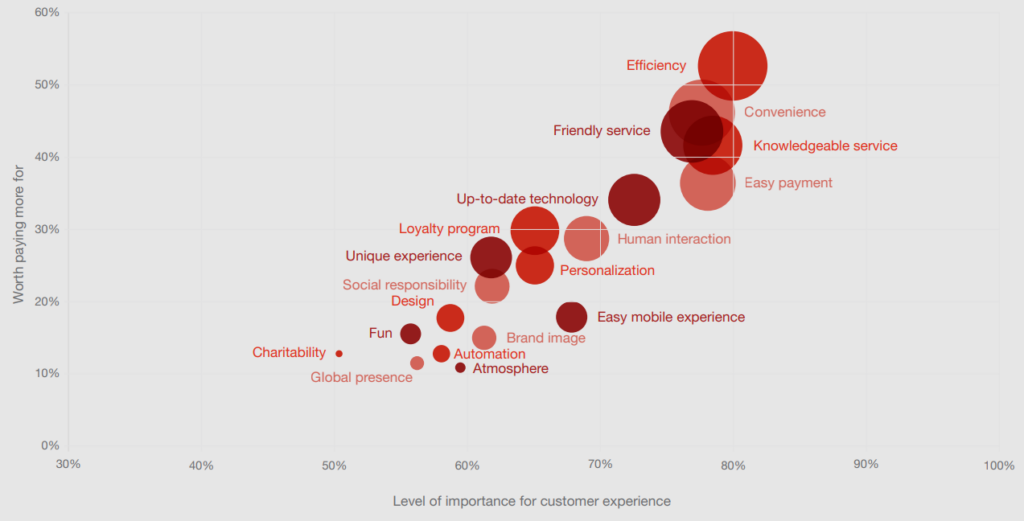
PWC shows in the publication  ‘Experience is everything’ what users in the US, Europe and other continents value most in their experience. Furthermore, their 2020 report, found that the number of companies investing in the omni-channel experience has jumped from 20% to more than 80%.

A customer journey map becomes incredibly powerful once empathy gets incorporated. When visualising customer motivations, drivers and pain point, essential insights become apparent and the developed actions become solutions. As cross-team alignments are created, responsibilities and opportunities will show clearly. So if your business is gearing up to change for the better, deliver greater and fuel sustainable growth through genuine connections and brand advocacy, then this is how you start!

3. How to map out the customer journey for your business

Depending on how many people and stakeholders are involved, how much data you gathered and how many touchpoints exist across the business, your customer journey mapping process can vary from days or weeks up to months of work. Allocate time and priority for this project to get involved parties on one (virtual) table. Create a diverse project team by involving different departments that all engage with customers differently and can provide unique views. 

Before you start, let’s get some prerequisites laid out for this process. Your project team will require a clear understanding of the goals and a defined use-case or persona. Relevant research and insights are essential as foundation for your compilation, i.e. website user data through tools such as Google analytics, heat mapsscrollmaps & A/B testing reports or survey data.
Last but not least your journey builders will need the willingness to jump in and be wrong. 

Phase I Lay out interactions

Start by breaking down the entire customer experience into sized interactions to reveal the individual touchpoints, from your customers point of view.  This may involve customer interviews, a brainstorming session in forms of workshops, or going through the journey as a customer yourself. 

Phase II Detail key activities

Lay out the key activities for each individual touchpoint, always from the customers perspective. What are they trying to achieve, find or solve and what do they need for this? What would be the emotional state your customer would be in right now and would they ultimately have a positive or negative experience with your business at current state? 

Phase III Measures & metrics

In this phase, your project team determined what makes each interaction successful, or not. For example, contacting customer support would be successful if the customer received an accurate answer in a reasonable time frame that provides a solution to the problem or the first step to it. Identifying the measures and metrics for the experience of each touchpoint helps make the customer journey map actionable.

Once your team determines whether the experience in each event or touchpoint is positive or negative, and you’ve identified moments of truth, naturally opportunities and actionable points for improvement reveal.
Look for moments of truth. These are one of the most important elements in your map. These are the aspects of your product or service that are the most important to your user. At core, these are the moments when a key event occurs and an opinion about the brand is formed in either a positive or negative direction. 

Phase IV Consolidate

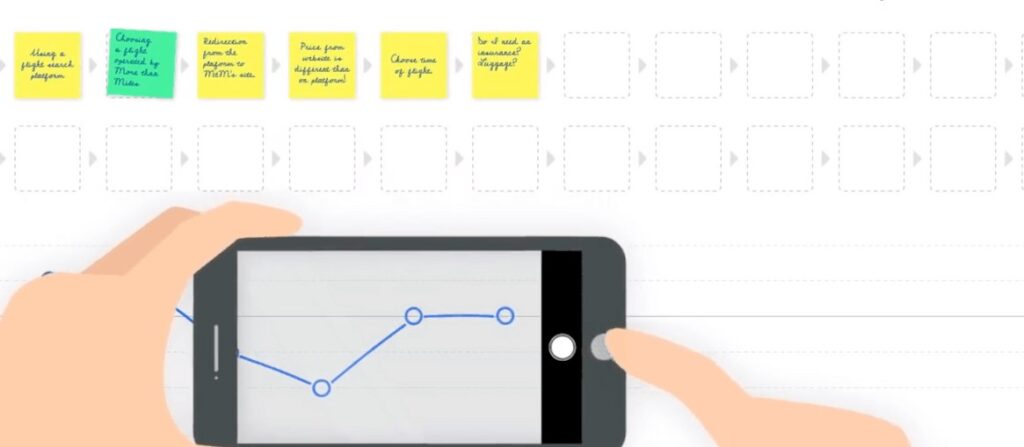
Now your project team will start to put the journey map together. Using the stages in your customer lifecycle such as customer acquisition, onboarding, trial, etc., each interaction is placed on the customer journey map. A simple visualisation method used are post-it-notes on a whiteboard for the first version of the customer journey map.

Phase V Dynamics of CX design

The customer journey map process doesn’t have a clear defined end, but rather evolves with your business dynamically. Frequent review , add, revise as necessary to use this as a tool for calibration and levelling up. If new insights and information become available to your business, shake up your visual journey map to use its potential for your success. 

4. Tips, best practices & pitfalls


Annette Franz, CEO of CX Journey Inc, alerts on pitfalls along the process, reveals tips and shares best practice examples of customer journey mapping in this video. 

5. Helpful tools

At the very beginning of your process, it is recommended to start with simple tools such as white boards, sticky notes, etc. but if your business has already moved for a digital set up, you can utilise the great tools of virtual meeting and collaboration tools such as Microsoft Teams, Zoom, Google Hangouts and others, depending on your companies protocol. 

Many CRM systems have the customer journey builder integrated into the entire customer service, communication and marketing funnel, i.e. Salesforce, Freshworks, Agile CRM, Hubspot or Insightly.  

If you wish to use stand alone tools to map out the customer journey map only Custellence or
Smaply may be a great fit for your business. 

The value of customer journey mapping to enhance your customer experience is of immense value, when done right and utilised for changement. When focussing on clear actions and priorities, your improvement is measurable. Data will provide powerful insights for your process and business, so assure secure GDPR compliant data collection at all times. 

If you have any questions or you’d like a helping hand when getting started, feel free to reach out to our team.